

Operating reality
This is not a global-optimizer problem.
Modern combat does not reward waiting for one coherent model of the world. Teams win by generating local tactical advantage faster than the environment changes.
Crebain Coordination Layer
Technology
Crebain turns autonomous systems into coordinated teams under degraded links, partial information, and fast-moving conditions, without relying on a central controller.
The system is built for environments where centralized orchestration arrives too late. Each node stays useful on its own while the team shares only what can change the local mission.
Control model
Crebain does not chase a perfect global picture. It keeps local decisions useful, communication relevant, and operator authority explicit.
Operating Reality
The environment is incomplete, links are stressed, and timing is unforgiving. The advantage goes to the team that can generate useful local decisions fastest.
Operating reality
Modern combat does not reward waiting for one coherent model of the world. Teams win by generating local tactical advantage faster than the environment changes.
Communication model
Information should move to the agents that can use it now, not to every node on the network.
Distributed Coordination Loop
Crebain decomposes coordinated decision-making into local state, situation-aware peer weighting, and fast action at the edge.
Peer-weighted merge
Not every peer matters equally.
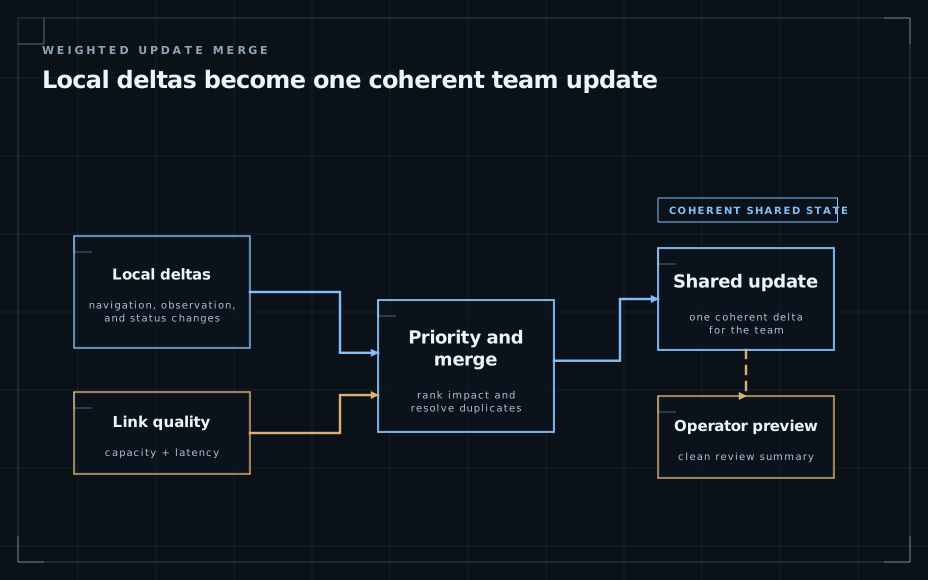
Local state
Crebain starts with local observation, local memory, and local geometry at the edge instead of depending on constant reach-back.
Peer weighting
The system weights the few peers that can actually influence the local mission, rather than mirroring full network traffic.
Bounded action
The result is coordinated behavior that stays legible to operators and bounded by explicit human authority.
Why It Works
Crebain is designed for local advantage, sparse communication, and operator-legible control.
Because a team that depends on constant reach-back is not really autonomous. When the link degrades, the system should keep coordinating locally instead of collapsing into disconnected nodes.
Because a perfect shared picture is not the real requirement. What matters is accurate local understanding where it can create tactical advantage.
Because only the peers that can affect the local mission need to matter. That keeps the network load low and the coordination model resilient under stress.
Rollout
Crebain fits beside current command software and vehicle systems, then grows outward only after the first bounded workflow proves out.
Current command environment
Crebain coordination service
Vehicle software and onboard systems
The Seeing-Stone Gate